Signed in as:
filler@godaddy.com

Experience the benefits of martial arts training. Build strength, endurance, and flexibility. Improve mind-body connection. Sign up for our classes today!

“Controling one’s self, and letting others do what they will. Does not mean I am weak. Controling your heart, and obeying the principles of life. This does not mean that others are stronger.
克己讓人非我弱。存心守道任他強。”
-Southern Dragon Style Kung Fu motto-

Tai Chi is an internal form of martial arts and a practice that involves a series of slow, gentle movements and physical postures. Considered a form of moving meditation, it requires a meditative state of mind and controlled breathing.
Where the Dragon attacks, Tai Chi yields. Often described as a moving meditation, our Tai Chi curriculum focuses on the profound internal mechanics of the body. It teaches the practitioner how to absorb and redirect incoming force rather than meeting it with aggression.
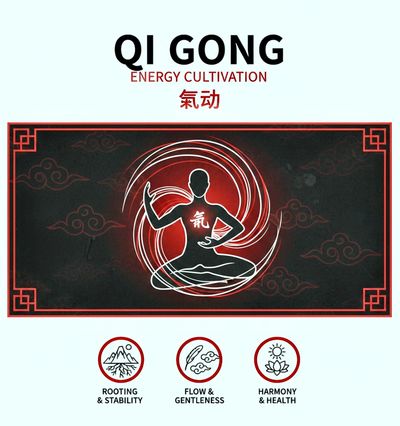
Qi Gong is a comprehensive system of coordinated body posture, movement, breathing, and meditation. Rooted in ancient Chinese medicine and philosophy, it is practiced to cultivate health, spirituality, and deep internal vitality.
A martial artist is only as strong as their internal energy. Qi Gong is the ancient practice of coordinating breath, movement, and awareness to cultivate Qi (life force). This is the secret engine that powers the devastating strikes of Lung Ying and the effortless flow of Tai Chi.

Tai Chi is an internal form of Chinese martial arts practiced for self-defense training, health benefits, and meditation. Chen, Yang, Wu, Sun and Hao Styles. Tai Chi's path is developing naturalness by relaxing, attending inward, and slowing mind, body, and breath. This allows us to become less tense, drop our conditioned habits, let go of thoughts, allow qi to flow smoothly, and be more in tune with ourselves. It is a form of moving meditation that will enable us to let go of the negative self and experience peaceful calm and spontaneity. There are five major family styles.
Qigong, pronounced "chi gong," was developed in China thousands of years ago as part of traditional Chinese medicine. It involves using exercises to optimize energy within the body, mind, and spirit to improve and maintain health and well-being. Qigong has psychological and physical components that regulate the mind, breath, and body's movement and posture.

I began my Tai Chi training with Master Yip to enhance the practice of Dragon Fist Kung Fu. After learning the 24 forms, I later learned and was certified to teach Wu Style. Under the patient guidance of Master Yip and Grand Master Ho Lai, I have grown to understand the importance of the external-internal and hard-soft aspects of the Dragon system.
Over the years, my Tai Chi practice has expanded to include several other empty hand forms, straight sword forms, fan forms, and broadsword forms. Although I do not like public displays of my martial arts, I have competed in several events. I enjoy teaching Tai Chi because separating the comparative qualities and focusing on the health benefits is easy.

Forms and stances are only the alphabet; this is where we teach you how to speak. Our Combat Principles track takes the traditional techniques of the Hakka masters and applies them to the chaotic reality of modern self-defense.

In Lung Ying, defense is not passive. Instead of blocking and retreating, practitioners aggressively "bridge the gap." By making heavy, bone-to-bone contact with the opponent's forearms, you learn to sense their kinetic energy, trap their hands, and instantly dismantle their guard at extremely close range.

In authentic Southern Hakka arts, the hands attack the upper gates while the feet dismantle the foundation. Lung Ying kicks are rarely aimed above the waist. They are fast, deceptive, and devastating—targeting the shins, knees, and groin. Because our kicks stay low, we never compromise our own balance or root, allowing us to crush the opponent's structure while our hands simultaneously deliver explosive strikes.

Lung Ying does not rely on isolated arm muscles to generate force. True explosive power dictates that the hand and the foot must arrive at the exact same millisecond. By syncing the breath (Daan Tin) with a whip-like spiraling of the waist (Yiu Lik), the practitioner delivers the entire weight of their body into a strike at zero distance.
In the authentic Hakka lineages, a weapon is never treated as a separate art; it is the ultimate test of your empty-hand foundation. At Kindred Fist, we train traditional weaponry—such as the Southern Long Pole and the Double Butterfly Swords—not as relics of the past, but as highly sophisticated tools to forge your body mechanics.
When you pick up a weapon in our Kwoon, you are learning to amplify the mechanics of the Dragon.

Mind and Weapon as One: In traditional Kung Fu, a weapon is never merely a tool held in the hand; it is a direct extension of your nervous system and your Qi. Training teaches you to project your focus, energy, and intent past your physical fingertips and through the very tip of the blade or pole.

Tendon and Bone Conditioning: Wielding traditional, heavy weapons—such as the Long Pole or Butterfly Swords—places extreme demand on the body. It forces the practitioner to sink their root deeper into the earth, rapidly developing the wrist strength, forearm density, and core stability required for devastating short-bridge power (Ging).
Hand Mechanics: Every weapon technique is a magnified empty-hand technique. The heavy leverage of a weapon will instantly expose any flaw or weakness in your stance and waist rotation. By mastering the weapon, you refine your fundamental body mechanics, making your unarmed strikes exponentially heavier and your defense unbreakable.

Forged in the same relentless crucibles of Southern China, Southern Dragon Fist (Lung Ying Kuen) shares an unbreakable combative DNA with its legendary sister arts—White Eyebrow (Bak Mei), Southern Praying Mantis (Nam Tong Long), Hung Family Fist (Hung Gar), and Spring Chant (Wing Chun)—united by a profound reliance on devastating close-quarter efficiency, deeply rooted stances, and explosive short-bridge power.
The Shared Context: Masters of the Close Quarter While each of these traditional systems developed its own unique flavor and specific strategies, they all emerged from the same geographical and cultural necessity. The Southern Chinese and Hakka people did not fight on wide-open plains; they fought in narrow alleyways, crowded villages, and on the slippery decks of boats. Flashy, high-flying kicks and wide, leaping acrobatics were a death sentence in these environments.
Because of this shared reality, Lung Ying and its sister arts evolved to share several uncompromising combat principles:
By training in Lung Ying at Kindred Fist, you are not just learning an isolated style; you are inheriting the most effective, battle-tested principles of the entire Southern Chinese martial arts lineage.

Born from the sacred halls of the Shaolin Temple, Southern Dragon Fist (Lung Ying Kuen) is not merely a single expression of combat, but the ultimate synthesis of the Shaolin Five Animals—unifying the structural ferocity of the Tiger, the evasive precision of the Crane, the blinding speed of the Leopard, and the coiling fluidity of the Snake under the supreme, commanding spirit of the Dragon.
The Energetic Principles of the Five Animals: To truly understand Lung Ying, one must understand the distinct energetic principles that the Shaolin monks originally cultivated. Each animal was designed to train a specific element of the human body and mind:
How Lung Ying Incorporates the Complete System: In Southern Dragon Fist, we do not isolate these energies; we fuse them into a single, devastating reality. While our system is named after the Dragon to emphasize the mastery of internal spirit and breath, every movement we execute relies on the foundation of the other four.
When you train at Kindred Fist, you will utilize the Tiger's rooted structural power in your deep stances. You will apply the Snake's coiling sensitivity during Mo Kiu (rubbing bridges) to control your opponent's limbs. You will unleash the Leopard's rapid-fire speed in close-quarter combinations, and maintain the Crane's perfect balance while yielding to incoming force. The Dragon governs them all, creating a martial artist who is physically unbreakable and spiritually grounded.

Practice and think about what you're going to do and why. Do not judge others, everyone has their own way.
All forms demand your focus, learn to be natural. Breath and follow the movement to understand your power.
Training that depends solely on physical ability has nothing to do with the discipline and development of the mind.
All training past and present has its benefits in helping you build a solid approach to your future goals.
Sharing your knowledge with like-minded individuals who are readily willing to give support and encouragement is vital when doubt begins to affect your goals.
Finding a teacher who knows the importance of training both the body and the mind is essential for proper guidance through your training from novice to advanced levels.
